
Rafiqul Islam Khokan
Executive Director, Rupantar
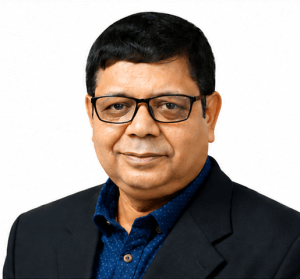
Rafiqul Islam Khokan has spent over 40 years at the forefront of community-based environmental and development work in Bangladesh’s southwestern coastal region. A development activist since 1984, he began his career in disaster management before expanding into environmental conservation, with a particular focus on biodiversity conservation of the Sundarban, the ecosystem at the heart of Rupantar’s water and climate resilience work.
As Executive Director of Rupantar since 1992, he provides the strategic vision and institutional oversight behind the organization’s environmental and water-focused programming, guiding initiatives in community-managed water access, sanitation infrastructure, and climate-resilient livelihoods for coastal communities. His leadership has steered Rupantar’s disaster risk reduction and climate resilience work from frontline relief toward locally led adaptation, a trajectory reflected in his participation in the 17th International Conference on Community-Based Adaptation to Climate Change (CBA17) in Bangkok.
Rafiqul has cultivated partnerships with government agencies and community institutions to embed environmental and WASH programming within local governance systems. He has represented Rupantar at international forums on localization and climate adaptation, including a conference on localization in Switzerland and the Open Government Partnership Summit in Tallinn, carrying community-level lessons from the Sundarban coast into global policy dialogue.
A pioneer of peace and tolerance programming within Bangladesh’s development sector, Rafiqul has championed social cohesion and pluralism as foundations for resilient communities, recognized through Rupantar’s representation at the Global Pluralism Award Ceremony in Ottawa and his engagement at an international conference on countering extremism and social media in the United Kingdom. He is also a recognized practitioner of Development Communication (DevCom), using folk media, community theatre, Pot Song, and grassroots publications to translate complex environmental and social messages into forms that resonate with coastal communities, an approach rooted in his early career as a researcher and writer on Bangladesh’s popular cultural forms.
He completed an international training course on Fiscal Decentralization and Local Government Financial Management at Duke University, USA, and continues to guide Rupantar’s research, documentation, and knowledge management on environmental conservation, climate resilience, and community development.